
3. Goals of the Political System - Justice, Liberty, Equality, Integrity, Fraternity.
4. Date of Adoption of the Indian Constitution - November 26, 1949.
Comments of Prominent Figures on the Preamble:
Preamble is like an identity card for the Indian Constitution - N.A. Palkhivala.
Preamble is like the life and soul of the Constitution - B. R. Ambedkar.
Preamble is the soul of the Constitution - Hidayatullah.
Preamble is like a key-note to the Indian Constitution - Ernest Barker.
Preamble is the horoscope of India - K.M. Munshi.
Compared the preamble to the American Declaration of Independence - Prof. Bombewala.
Preamble is described as the life, source, key, jewel, most important part of the constitution, and a measure to assess the constitution - Thakurdas Bhargava.
Is Preamble a part of the Constitution or not?
Constituent Assembly member Mahavir Tyagi commented that the preamble is not a part of the constitution.
Constituent Assembly Chairman Dr. Babu Rajendra Prasad stated that the preamble is indeed an integral part of the constitution.
In the Berubari case (1960) and A.K. Gopalan case (1951), the Supreme Court ruled that the preamble is not a part of the constitution.
Note: Berubari, a small territory, was given to Pakistan in 1960 as per the 9th Constitutional Amendment Act, 1960, under the India-Pakistan agreement of 1958.
In the Kesavananda Bharati VS Kerala case in 1973, the Supreme Court ruled that the preamble is an integral part of the constitution.
In the Minerva Mills case (1980) and S.R. Bommai case (1994), the Supreme Court ruled that the preamble is an integral part of the basic structure of the constitution.
In the LIC of India case in 1995, the Supreme Court ruled that the preamble is an integral part of the constitution.
Currently, the preamble is an integral part of the constitution but is not legally enforceable.
The 42nd Constitutional Amendment included these words in the Preamble.
- Socialist, Secular
- Socialist, Secular, Democratic
- Socialist, Secular and Unity
- Socialist, Secular and Integrity
(Answer: 4) Socialist, Secular and Integrity) (AP Constable Prelims-2016)
Concepts in the Preamble of the Constitution:
11 ideals are mentioned in the Preamble.
1. Sovereignty:
Article 5 of the Constitution mentions this word, and Fundamental Duties 51 (A), (C) mentions it.
Sovereignty or sovereign power means India is a completely independent country.
Sovereign means supreme authority. In India, this authority belongs to the people.
Parliament exercises this authority on behalf of the people.
India became a sovereign nation on August 15, 1947. Thus, no one can control India externally or internally.
2. Socialism:
Socialism means establishing a society of equals.
If the means of production are in the hands of the government, it is called socialism.
Democratic socialism is in practice in India. Jawaharlal Nehru is the pioneer of this.
The word Socialism was added to the Preamble of the Constitution through the 42nd Constitutional Amendment in 1976.
Even though the word Socialism was added in 1976, from the time of independence itself, socialism has been implemented, aspiring for a society of equals.
In the Industrial Policies of 1948 and 1956, the strategy of dominance of the public sector and continuation of the private sector was followed.
Directive Principles in Part 4 of the Constitution contain socialist features.
The Planning Commission established on March 15, 1950, is an integral part of socialism.
In the Avadi (1955) Congress meeting, Nehru resolved that establishing a socialist pattern of society is the goal of Congress.
3. Secular:
A state without religious affiliation is called a secular state.
India is following secularism. Its main features are:
- There is no official religion for India.
- All religions are equal in the eyes of the state.
- The state does not interfere in religious affairs.
- Religious tolerance is the main feature of Indian society.
- Religion-neutral state.
- Not a religion-based state.
Countries like Pakistan, Afghanistan, Iraq, Iran are theocratic states. In these countries, Islam is officially recognized as the state religion.
Articles 25-28 of the Constitution deal with this word.
There is direct and indirect democracy in India.
Largest democracy - India, America, Indonesia.
4. Democracy:
In the classification of modern governments, democracy is the highest.
A government in which every individual has a share is called democracy.
Democracy in English is called Democracy. This word is derived from the combination of Greek words Demos and Cratio.
Demos means people and Cratio means power.
Democracy is a government that empowers the people.
"Government of the people, by the people, for the people is democracy" - Abraham Lincoln.
"Democracy is a government in which everyone has a share" - Professor Seeley.
Types of Democracy -
Democracy can be divided into two types. They are -
- Direct Democracy: Direct democracy is when people not only directly elect the government but also participate in government affairs.
- Referendum: Referendum is obtaining people's approval for government laws.
Currently, complete direct democracy is in practice in Switzerland.
Direct democracy is visible in the functioning of village assemblies in India.
In this system, people participate in administration through direct democracy instruments. These instruments are -
Note: Junagadh princely state merged into India through Referendum (1948).
Note: Sylhet district in Assam merged into Pakistan through Referendum (1947).
- Initiative: Initiative is when people request the government to make a law on a matter.
- Recall: Recall is when people have the power to call back or remove an elected representative. This is called Recall.
- Plebiscite: Plebiscite is taking people's decision on a matter of public importance.
Note: This system is in practice in Switzerland.
Note: Demand for conducting Plebiscite in the case of Jammu and Kashmir has been there for many days.
- Indirect Democracy:
Indirect democracy is when people indirectly elect the government. This is also called Representative Democracy. Currently, it is in practice in our country.
In this system, there are representatives elected by the people between the people and the government. That is why it is called Representative Democracy.
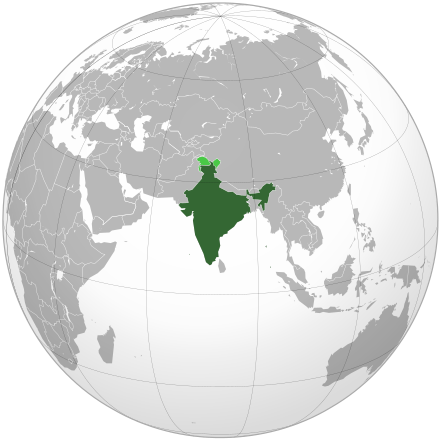
Map of India (Example, replace with local map if needed)
Second largest democracy - America.
5. Republic:
Article 54 explains about this word.
A country is called a republic if the head of state is elected by the people, directly or indirectly. There is no scope for heredity in this system.
India became a republic on January 26, 1950.
The concept of republic is borrowed from the French Constitution.
Note: The first republic country in the world - Netherlands (1795).
Another name for Netherlands - Holland.
Largest republic in the world - China.
Smallest republic in the world - Nauru.
Republic kingdoms in India during Mahajanapadas - Malla, Vajji.
Chief guest for the first Republic Day celebrations in India - Sukarno (Indonesia).
* Identify the correct statements in the following statement/statements.
- India is the largest democracy in the world.
- India has direct democracy.
- 'Recall' a direct democracy method is mentioned in the Indian Constitution.
- India has parliamentary democracy.
(Answer: 1) a, d, e (Note: There's likely a typo in the original answer options provided as 'e' is not in the list. Assuming 'd' was meant to be included.) Corrected Answer: 1) a, d
(AP SI-2018)
* Reason (A): India is a republic.
Cause (R): India has a universal adult franchise system.
Choose the correct answer:
- (A) and (R) are both true and (R) is the correct explanation for (A)
- (A) and (R) are both true but (R) is not the correct explanation for (A)
- (A) is true and (R) is false
- (A) is false and (R) is true
(Answer: 1) (A) and (R) are both true and (R) is the correct explanation for (A)) (Telangana Constables Mains – 2016)
No comments:
Post a Comment