
Indian Polity Notes (Complete)
Notes:
- India's first internationally recognized tourist center - Auroville area.
- 'New Lamps for the Old' is considered the Bible of extremist literature.
- Aurobindo Ghosh's other works include Life Divine, Bhavani Mandir, Savitri.
- Vande Mataram was last sung at the INC session of "1948".
* In which Indian National Congress session was Vande Mataram sung for the first time?
- 1896 Calcutta Session
- 1908 Madras Session
- 1895 Pune Session
- 1899 Lucknow Session
(Answer: 1) 1896 Calcutta Session) (As per - 22-02-2019)
| Number | Category | Representation |
|---|---|---|
| 1. | Indian National Congress | Nehru, Patel, Rajendra Prasad, Pattabhi Sitaramayya |
| 2. | Muslims | Sayyid Muhammad Saadulla, Maulana Abul Kalam Azad |
| 3. | Sikhs | Sardar Baldev Singh, Hukum Singh |
| 4. | Anglo-Indians | Frank Anthony |
| 5. | Parsees | Dr. H.P. Modi |
| 6. | Hindu Mahasabha | Dr. Shyama Prasad Mukherjee, M.R. Jayakar |
| 7. | All India Scheduled Castes Federation | Dr. B.R. Ambedkar |
| 8. | All India Women's Conference | Hansa Mehta |
| 9. | All India Zamindars' Association | Darbhanga Maharaja |
| 10. | All India Labour Federation | Babu Jagjivan Ram |
| 11. | Minorities | Dr. H.C. Mukherjee |
Following the British tradition of committees, the Constituent Assembly established 22 types of committees for the constitution drafting. Among them, Policy Determining Committees - 10, Subject Determining Committees - 12.
| Committee | Chairman |
|---|---|
| Financial and Staff Committee (Policy) | Rajendra Prasad |
| Steering Committee (Policy) | Rajendra Prasad |
| Rules Committee (Policy) | Rajendra Prasad |
| Flag Committee (Ad-hoc) | Rajendra Prasad |
| Union Constitution Committee (Subject) | Jawaharlal Nehru |
| Union Powers Committee (Subject) | Jawaharlal Nehru |
| States Negotiating Committee (Subject) | Jawaharlal Nehru |
| Provincial Constitution Committee (Subject) | Vallabhbhai Patel |
| Provincial Powers Committee (Subject) | Vallabhbhai Patel |
| Advisory Committee (Subject) | Vallabhbhai Patel |
| House Committee (Policy) | Bhogaraju Pattabhi Sitaramayya |
| Chief Commissioners Provinces Committee (Subject) | Bhogaraju Pattabhi Sitaramayya |
| Order of Business Committee (Policy) | K.M. Munshi |
| Supreme Court Ad-hoc Committee (Subject) | S. Varadachariar |
| Credentials Committee (Subject) | Alladi Krishnaswamy Ayyar |
| Constituent Assembly Functions Committee | G.V. Mavalankar |
Note: The largest committee among the Constituent Assembly Committees - Advisory Committee.
- In the Advisory Committee, 1 Chairman + 54 members = 55 members were there.
- The Advisory Committee had four sub-committees.
- Fundamental Rights Sub-Committee - J.B. Kripalani
- Minorities Sub-Committee - H.C. Mukherjee
- North-East Frontier Tribal Areas and Assam Sub-Committee - Gopinath Bardoloi
- Other Areas Tribal Areas Sub-Committee - A.V. Thakkar
Drafting Committee / Drafting Committee or Constitution Drafting Committee:
- This committee was formed on August 29, 1947.
- The most important committee among the Constituent Assembly committees.
- The number of members in this committee was 1 Chairman and 6 members.
- Drafting Committee Chairman - B.R. Ambedkar.
- Other members:
- Gopalaswami Ayyangar
- Alladi Krishnaswamy Ayyar
- K.M. Munshi
- Sayyid Muhammad Saadulla
- D.P. Khaitan (died in between)
- B.L. Mitter (resigned in between)
- Those who were appointed in place of the deceased/resigned members -
- T.T. Krishnamachari (in place of D.P. Khaitan) - The only member among the committee members who had studied law.
- N. Madhava Rau (in place of B.L. Mitter)
- * Who was not a member of the Drafting Committee of the Indian Constituent Assembly? (AP SI - 2018)
- N. Gopalaswami Ayyangar
- N. Madhava Rau
- J.B. Kripalani
- T.T. Krishnamachari
B.R. Ambedkar:
- Born on April 14, 1891, in Mhow, Madhya Pradesh.
- Original name given by parents - Ambavadekar Bhimrao.
- R in 'B.R.' stands for Ramji (father's name).
- B in 'B.R.' stands for Bhimabai (mother's name).
- Ambedkar's teacher's name - Ambavadekar - Surname.
- First graduate in the Mahar caste.
- Known as the modern Manu.
- Father of the Indian Constitution.
- Worked as Chairman of the Drafting Committee.
- Famous as the architect of the Indian Constitution.
- In 1932, the Poona Pact took place between Ambedkar and Gandhi. (September 24, 1932)
Institutions established by Ambedkar:
- Bahishkrit Hitakarini Sabha - 1924
- Samata Sangh - 1927
- All India SC Federation - 1942
- People's Education Society - 1945
Parties established by Ambedkar:
- Independent Labour Party - 1936
- Republican Party - 1956
Journals started:
- Mook Nayak
- Janata
- Bahishkrit Bharat
Methods chosen by the Constituent Assembly for policy decisions:
- Consensus: Unanimous or near unanimous agreement of all members in decisions.
- Coordination Method: If mutual opposition arises between one's own idea and another's idea, giving value to the right opinion with discretion.
- Method of Adoption (Compromise):
- The first person to address the Constituent Assembly was Dr. Sachchidananda Sinha.
- The last British Governor-General to speak to the Constituent Assembly - Lord Mountbatten.
- Secretary of the Constituent Assembly - H.V. Iyengar.
- Chief Draftsman of the Constituent Assembly - N.C. Mukherjee.
Legal Advisor to the Constituent Assembly - B.N. Rau.
B.N. Rau's draft contained 243 articles and 13 appendices.
Note: The first Indian to work in the International Court of Justice was B.N. Rau.
Time taken to prepare the Indian Constitution - 2 years, 11 months, and 18 days.
Time taken for drafting the Indian Constitution - 2 years, 11 months, and 17 days.
The draft constitution contained 315 articles and 8 appendices.
Expenditure incurred for the preparation of the Indian Constitution - 64 Lakhs.
Symbol of the Indian Constituent Assembly - White Elephant (Airavata). A symbol of elephant's strength and power.
The Constituent Assembly adopted the National Flag on - August 22, 1947.
Note: Ratio of length and width in the National Flag is 3:2.
Saffron color in the National Flag (Saffron) symbolizes sacrifice, white color symbolizes truth, green color represents our connection with the soil and green plants.
The designer of the National Flag is Pingali Venkayya.
B.R. Ambedkar was initially elected from Bengal, but lost representation due to the partition of the country. Later, he was nominated from Bombay State.
Somnath Lahiri (Communist Party) lost membership in the Constituent Assembly due to the partition of the country.
Number of nominated members in the Constituent Assembly - 15.
24 Americans participated in the Constitutional debates for 7 days.
Until the Constitution was adopted, the Constituent Assembly met 11 times and conducted proceedings for 165 days.
Members of the Constituent Assembly (284 out of 299 total) signed the Constitution copy on - January 24, 1950.
Day the Draft Constitution was submitted to the Constituent Assembly - November 5, 1947.
Day the Constitution draft was printed and distributed to members and the press - February 21, 1948.
Day the Constituent Assembly started discussing the Draft Constitution - November 4, 1948.
The Constituent Assembly studied approximately 60 countries' constitutions.
The Indian Constitution was beautifully handwritten in English by - Prem Behari Narain Raizada.
Written in Hindi by - Shri Vasant Krishan Vaidya.
Each page was artistically designed to reflect Indian culture by - Nandalal Bose and artists from Shantiniketan.
Although discussions in the Constituent Assembly took place in many languages, the Constitution was written only in Hindi and English.
Amendments proposed to the Draft Constitution - 7635. Of these, the Constituent Assembly resolved - 2473.
The person who proposed the most constitutional amendments - H.V. Kamath.
Hansa Mehta introduced the flag designed by Pingali Venkayya in the Constituent Assembly.
'India is my Motherland' pledge was written by - Paidimarri Venkata Subba Rao.
Prominent leaders who were not members of the Constituent Assembly - Mahatma Gandhi, Muhammad Ali Jinnah.
Shyama Prasad Mukherjee (Bengal) was elected as a member even after losing in the Constituent Assembly elections.
Extraordinary members nominated without contest - Sarvepalli Radhakrishnan, K.T. Shah, Gopalaswami Ayyangar.
Comments and criticisms of prominent figures on the Constituent Assembly:
- Indian Constitution is a patchwork quilt - Granville Austin.
- Indian Constitution is a lawyer's paradise - Ivor Jennings.
- Indian Constitution is lengthy and divine - Ivor Jennings.
- Weak federation with strong centralizing tendencies - Ivor Jennings.
- Indian Constitution is a bag of borrowings - Ivor Jennings.
- Indian Constitution is quasi-federal - K.C. Wheare.
- Indian Constitution is cooperative federation - Granville Austin.
- Indian Constitution is a bargaining federation - Morris Jones.
- Constituent Assembly is a one-party body - Granville Austin.
- Constituent Assembly is a Hindu-dominated body - Viscount Simon.
- The Indian Constitution has a nature to function as a federation in normal circumstances and as a unitary in emergencies - B.R. Ambedkar.
- The Indian Constitution is in a way that fulfills the needs of the Indian people - Nehru.
Sources of the Indian Constitution from the Constitutions of various countries in the world:
| 1. USA: | 2. England Constitution |
|---|---|
|
|
| 3. Canada: | 4. France: |
|
|
| 5. Russia (Soviet Union): | 6. Ireland: |
|
|
| 7. Australia: | 8. South Africa: |
|
|
| 9. Germany: | 10. South Korea: |
|
|
| 11. Japan: | |
|
* The advisory jurisdiction of the Indian Supreme Court is derived from which of the following constitutions? (AP SI – 2018)
- American Constitution
- Australian Constitution
- South African Constitution
- Canadian Constitution
(Answer: 4) Canadian Constitution)
* Directive Principles are derived from which constitution? (AP Constable - 2019)
- America
- Britain
- France
- Ireland
(Answer: 4) Ireland)
* What is the main basis for the Indian Constitution? (AP Constable – 2016)
- American Constitution
- French Constitution
- British Constitution
- Government of India Act - 1935
(Answer: 4) Government of India Act - 1935)
Schedules in the Indian Constitution
* Which of the following schedules in the Indian Constitution contains matters related to Municipal Corporations?
- 12th Schedule
- 9th Schedule
- 11th Schedule
- 10th Schedule
(Answer: 1) 12th Schedule) (AP Constable - 2018)
* In which of the following years was the 52nd Constitutional Amendment Act related to the prohibition of defections passed?
- 1980
- 1985
- 1989
- 1991
(Answer: 2) 1985) (AP Constable – 2018)
1st Schedule: Describes the territory of India (States, Union Territories in the country).
2nd Schedule: Salaries, allowances, and privileges of dignitaries.
3rd Schedule: Oath of office and responsibilities of dignitaries like President, Vice-President, Governor, etc.
4th Schedule: Details of allocation of seats to states in Rajya Sabha.
5th Schedule: Administration of Scheduled Tribes and areas.
6th Schedule: Administration of tribal areas in the states of Assam, Meghalaya, Tripura, Mizoram.
7th Schedule: Jurisdiction of legislative powers of the Union and States, details of three lists.
8th Schedule: Officially recognized languages of the Constitution (Initially 14, currently 22).
9th Schedule: Laws related to land reforms - 9th Schedule was added to the Constitution in 1951 through the First Constitutional Amendment. There is no power to conduct judicial review in court on the matters in the 9th Schedule.
- Matters in this schedule do not come under the jurisdiction of the court. However, in a judgment (Coelho/Tamil Nadu, 2007), the Supreme Court stated that the 9th Schedule also comes under judicial review.
10th Schedule: Anti-Defection Law - This 10th Schedule was added to the Constitution through the 52nd Amendment (1985). According to the Supreme Court's judgment, party whips apply only to motions of confidence and no-confidence. The Anti-Defection Law does not apply to Speaker, Deputy Speaker, Deputy Chairman. 2003, 91st Constitutional Amendment Act Anti-Defection Law, Amendment Act.
11th Schedule: Powers and functions of Panchayat Raj - In 1992, the 11th Schedule was added through the 73rd Constitutional Amendment. About this, 29 powers are added in Article 243 (G) of the Constitution.
12th Schedule: Powers and functions of Municipalities - About these, 18 functions are added in Article 243 (W) of the Constitution. Their term, functions. In 1992, the 12th Schedule was added to the Constitution through the 74th Constitutional Amendment.
* Schedules were proposed at the end of the Constitution. Schedule means appendix. In this, explanations / interpretations / additional information related to the Constitution are included.
Parts of the Constitution - 25
| Part No. | Topic | Articles (Sections) |
|---|---|---|
| 1 | Territory of India, States, Union Territories | 1 - 4 |
| 2 | Citizenship | 5 - 11 |
| 3 | Fundamental Rights | 12 - 35 |
| 4 | Directive Principles of State Policy | 36 - 51 |
| 4A | Fundamental Duties (Added by the 42nd Constitutional Amendment, 1976) | 51 A |
| 5 | The Union Government | 52 - 151 |
| 6 | The State Governments | 152 - 237 |
| 7 | (Deleted by the 7th Constitutional Amendment, 1956) | 238 |
| 8 | Union Territories | 239 - 242 |
| 9 | Panchayat System (Added by the 73rd Amendment) | 243 A - 243 O |
| 9A | Municipalities, Nagar Palika (Added by the 74th Amendment) | 243 P - 243 ZG |
| 9B | Formation of Cooperative Societies (Added by the 97th Constitutional Amendment) | 243 ZH - 243 ZT |
| 10 | Scheduled and Tribal Areas | 244 - 244 A |
| 11 | Union-State Legislative and Administrative Relations | 245 - 263 |
| 12 | Financial Relations between the Union and States | 264 - 300 A |
| 13 | Trade, Commerce and Intercourse within the territory of India | 301 - 307 A |
| 14 | Services Under the Union and the States | 308 - 323 A |
| 14 A | Administrative Tribunals (Added by the 42nd Amendment - 1976) | 323 A, B |
| 15 | Elections | 324 - 329 A |
| 16 | Special Provisions Relating to Certain Classes | 330 - 342 |
| 17 | Official Languages | 343 - 351 |
| 18 | Emergency Provisions | 352 - 360 |
| 19 | Protection of President and Governors, Miscellaneous Items | 361 - 367 |
| 20 | Amendment of the Constitution | 368 |
| 21 | Temporary, Transitional and Special Provisions | 369 - 392 |
| 22 | Title - Authoritative text in Hindi and Repeals | 393 - 395 |
Currently there are 25 parts - (4A, 9A, 9B, 14A are additions).
Part 7 and Part 9 of the original constitution were repealed by the 7th Constitutional Amendment in 1956.
Part 9 was reintroduced by the 73rd Constitutional Amendment Act in 1992.
A Part signifies a collection of constitutional provisions related to a single topic.
Newly added parts in the Indian Constitution - 4 (4A, 9A, 9B, 14A).
Smallest part in the Indian Constitution - Part 20.
Largest part in the Indian Constitution - Part 5.
Salient Features of the Indian Constitution
(SALIENT FEATURES OF THE INDIAN CONSTITUTION)
General and Unique Features:
Every written constitution in the world has general and unique features.
The political, cultural, and historical conditions prevailing in the country at the time of drafting the constitution are reflected in these features. Such features are abundant in the Indian Constitution as well.
- Largest Written Constitution
- Rigid and Flexible Constitution
- Federal and Unitary State
- Citizenship
- Fundamental Rights
- Directive Principles
- Fundamental Duties
- Parliamentary Form of Government
- Federal System with Unitary Features
* In which of the following years did Indian citizens who completed 18 years of age use their voting right for the first time in the general elections held for the Lok Sabha?
- 1984
- 1996
- 1991
- 1989
(Answer: 4) 1989) (AP Constable - 2018)
* Identify the incorrect statement among the following.
- India has Direct Democracy
- India has a Federal System of Government
- India is a Republic
- India is a Secular State
(Answer: 1) India has Direct Democracy) (AP Constable - 2018)
1. Largest Written Constitution:
The Indian Constitution is the largest written constitution in the world.
When the constitution came into force, i.e., on January 26, 1950, it had 395 articles, 22 parts, and 8 schedules. The total number of pages was 403. The number of English words was 1,17,369.
Currently, there are 470 articles, 25 parts, 12 schedules, and 5 appendices.
Note: Numbered Articles - 395, Numbered Parts - 22.
2. Citizenship:
India provides single citizenship to its citizens.
Dual citizenship is in force in America and Switzerland.
3. Rigid - Flexible Constitution:
Flexible Constitution: A constitution is called flexible if the same procedure used for making ordinary laws is followed for constitutional amendments.
Rigid Constitution: A constitution is called rigid if a special difficult procedure is required for constitutional amendments.
The Indian constitutional amendment procedure is borrowed from the South African Constitution.
Constitutional amendment is explained in Article 368 in Part 20 of the Constitution.
There are three types of methods in the constitutional amendment procedure. They are -
- Parliament can amend some provisions of the constitution with a simple majority (1/2 majority).
Example: Formation of new states, changing the names and boundaries of states.
- Parliament amends some provisions of the constitution with a unilateral special majority (2/3 majority).
Example: Amending Directive Principles, Fundamental Rights.
- If, along with a 2/3rd majority in Parliament, more than half of the state legislatures ratify with a simple majority, then some provisions of the constitution can be amended.
Example: Procedure for presidential election, Union-State relations, matters related to the Supreme Court.
4. Federal Unitary State:
Article 1 of the Constitution declares India as a Union of States (Union of States).
Features of a Federal State: Written constitution, distribution of powers, independent judiciary, rigid constitution.
The term 'Federal State' is nowhere in the Constitution.
Residual powers empowering the central government are given to the center.
Both the state and the center have the power to legislate on items in the Concurrent List. But ultimate authority rests with the central government.
Residual powers belonging to the central government is a feature of a unitary state.
Ambedkar described the Indian Constitution as a 'highly centralized federal state'.
Federal and Unitary features in the Indian Constitution:
| Federal Features | Unitary Features |
|---|---|
| 1. Division of powers between Center and States | 1. Single Citizenship |
| 2. Written Constitution | 2. All India Services |
| 3. Bicameral Legislature | 3. Governor System |
| 4. Independent Judiciary | 4. Central Supremacy over States |
| 5. Dual Governments | 5. Single State |
| 6. Constitutional Supremacy | 6. Residual Powers belong to the Center |
| 7. Integrated Judiciary | |
| 8. President's Emergency Powers |
5. Socialist, Secular State Features:
The Preamble of the Indian Constitution declares India as a Secular State.
"The state does not exhibit special favorable or unfavorable attitude towards any particular religion."
In 1976, the words 'Socialist', 'Secular', and 'Integrity' were added to the Preamble through the 42nd Constitutional Amendment.
Socialism means establishing a society of equals, minimizing the gaps between rich and poor, and government control over production forces.
6. Universal Adult Suffrage:
Article 326 grants voting rights to all citizens of India without discrimination based on caste, religion, color, language, region, property, or gender.
When the constitution came into force, the eligibility age for voting was 21 years. In 1988, the minimum voting age was reduced to 18 years through the 61st Constitutional Amendment. (Effective from March 28, 1989)
* Constitutional Amendment Act that reduced the voting age from 21 to 18 years
- 69th Constitutional Amendment Act
- 61st Constitutional Amendment Act
- 63rd Constitutional Amendment Act
- 66th Constitutional Amendment Act
(Answer: 2) 61st Constitutional Amendment Act) (AP Constable - 2019)
Assertion (A): Citizens in a federal country generally have dual citizenship. Although India is a federal country, Indian citizens have single citizenship.
Reason (R): India adopts a single citizenship policy with the aim of suppressing disruptive forces and protecting national integration.
Choose the correct answer:
- (A) and (R) are both true and (R) is the correct explanation for (A)
- (A) and (R) are both true but (R) is not the correct explanation for (A)
- (A) is true and (R) is false
- (A) is false and (R) is true
(Answer: 1) (A) and (R) are both true and (R) is the correct explanation for (A))
7. Parliamentary Government System:
The Indian Constitution established 'Westminster' style parliamentary governments in both the center and the states.
In the center, the President, and in the state, the Governor, act as nominal executive heads.

Image of Indian Parliament House (Example, replace with local image if needed)
The Council of Ministers headed by the Prime Minister at the center, and the Council of Ministers headed by the Chief Minister in the state, hold real executive powers.
8. Fundamental Rights:
Like the American Constitution, the Fundamental Rights are enshrined in Part III of the Indian Constitution, from Articles 12 to 35.
The original constitution had seven fundamental rights.
But through the 44th Constitutional Amendment in 1978, the Right to Property was removed from the list of Fundamental Rights. So, currently, there are only 6 fundamental rights.
These rights stand as proof of equilibrium between constitutional supremacy and parliamentary sovereignty.
9. Fundamental Duties:
The original constitution did not mention Fundamental Duties.
In 1976, through the 42nd Constitutional Amendment, ten duties were incorporated in Article 51A in Part 4A of the Indian Constitution.
Later, through the 86th Constitutional Amendment Act (2002), another fundamental duty was added. With this, their number reached 11.
10. Directive Principles:
Directive Principles are enshrined in Part IV, from Articles 36 to 51.
These are guiding principles given to the central and state governments to achieve the noble ideals in the Preamble of the Constitution.
Their main purpose is to establish a socialist pattern of society. However, these principles are not enforceable by law.
11. Division of Powers:
Although the Indian Constitution declared the country as a Union of States, the distribution of powers is constitutionally mandated.
Powers are divided into three lists.
These lists are the Union List, State List, and Concurrent List.
12. Sovereign, Socialist, Secular, Democratic Republic:
As mentioned in the Preamble of the Constitution, our constitution established a Sovereign, Socialist, Secular, Democratic Republic.
Internally, it has supreme authority, and externally, it has independent authority in foreign affairs. It is not subordinate to any foreign power.
People are the source of constitutional systems and power.
The President, Prime Minister, and other representatives are elected by the people for a fixed term.
13. Bicameral Legislature:
According to the Constitution, the central parliament has a bicameral system.
The lower house of Parliament is called the Lok Sabha and the upper house is called the Rajya Sabha. However, in states, the bicameral system is optional.
Currently, only six states have a bicameral system. (Recently, with the conversion of the state of Jammu and Kashmir into the Union Territories of Jammu and Kashmir and Ladakh, the state legislature of that state was also abolished.)
The lower house in a state is called the Legislative Assembly (Vidhan Sabha), and the upper house is called the Legislative Council (Vidhan Parishad).
14. Central Supremacy During Emergency:
Articles 352 to 360 in Part 18 of the Constitution describe emergency provisions.
* These special powers can be exercised when the unity, integrity, security, and sovereignty of the country are threatened.
Three types of emergencies are mentioned. They are:
- National Emergency (Article 352)
- Constitutional Emergency (President's Rule) (Article 356)
- Financial Emergency (Article 360)
Preamble of the Constitution (Preamble):
The Indian Constitution begins with the Preamble.
It can be called the introduction to the Indian Constitution.
The Preamble is also known as the preface, foreword, summary, abstract, keynote, and preamble.
The Preamble is like a mirror to the Constitution.
The Preamble reveals the philosophical foundations of the Constitution.
The Preamble is the essence of the basic features of the Constitution.
Author of the Preamble - Nehru (Proposed).
* Consider the following items related to National Integration.
- 'We, the people of India' begins the Preamble of the Indian Constitution (Preamble).
- Indian Constitutional Directive (Directive) Principles direct states to take actions towards ensuring equality, justice, and freedom for all.
Select the correct answers.
- Both A and B are correct
- Both A and B are incorrect
- Only A is correct
- Only B is correct
(Answer: 3) Only A is correct) (TSLPRBT-2018)
Basis of the Preamble:
The 'Objectives Resolution' introduced by Jawaharlal Nehru in the Constituent Assembly on December 13, 1946, is the main basis.
Liberty, Equality, Fraternity, which influenced the French Revolution (1789), served as inspiration for the Preamble.
The ideas of Social, Economic, and Political Justice included in the Preamble are borrowed from the Russian Revolution (1917).
The concept of the Preamble is adopted from the American Constitution.
The Preamble of the Constitution reveals the objective of the Indian Constitution.
The Preamble of the Constitution:
“WE, THE PEOPLE OF INDIA, having solemnly resolved to constitute India into a SOVEREIGN SOCIALIST SECULAR DEMOCRATIC REPUBLIC and to secure to all its citizens:
JUSTICE, social, economic and political;
LIBERTY of thought, expression, belief, faith and worship;
EQUALITY of status and of opportunity;
and to promote among them all
FRATERNITY assuring the dignity of the individual and the unity and integrity of the Nation;
IN OUR CONSTITUENT ASSEMBLY this twenty-sixth day of November, 1949, do HEREBY ADOPT, ENACT AND GIVE TO OURSELVES THIS CONSTITUTION.”
Note: Sculptor who carved the Preamble of the Indian Constitution (Art of work) - Nandalal Bose.
Preamble means a constructive index.
Total words in the Preamble - 73.
Real artist of the Preamble (Artwork) - Beohar Ram Manohar Sinha.
Main word in the Preamble - We, the People of India.
Preamble became law on - November 26, 1945 (Typo in original text, should be 1949), November 26, 1949.
Key Points Seen in the Preamble:
- Source of Authority in India - The People
- Nature of the Government - Sovereign, Socialist, Secular, Democratic, Republic
- Goals of the Political System - Justice, Liberty, Equality, Integrity, Fraternity.
- Date of Adoption of the Indian Constitution - November 26, 1949.
Comments of Prominent Figures on the Preamble:
Preamble is like an identity card for the Indian Constitution - N.A. Palkhivala.
Preamble is like the life and soul of the Constitution - B. R. Ambedkar.
Preamble is the soul of the Constitution - Hidayatullah.
Preamble is like a key-note to the Indian Constitution - Ernest Barker.
Preamble is the horoscope of India - K.M. Munshi.
Compared the preamble to the American Declaration of Independence - Prof. Bombewala.
Preamble is described as the life, source, key, jewel, most important part of the constitution, and a measure to assess the constitution - Thakurdas Bhargava.
Is Preamble a part of the Constitution or not?
Constituent Assembly member Mahavir Tyagi commented that the preamble is not a part of the constitution.
Constituent Assembly Chairman Dr. Babu Rajendra Prasad stated that the preamble is indeed an integral part of the constitution.
In the Berubari case (1960) and A.K. Gopalan case (1951), the Supreme Court ruled that the preamble is not a part of the constitution.
Note: Berubari, a small territory, was given to Pakistan in 1960 as per the 9th Constitutional Amendment Act, 1960, under the India-Pakistan agreement of 1958.
In the Kesavananda Bharati VS Kerala case in 1973, the Supreme Court ruled that the preamble is an integral part of the constitution.
In the Minerva Mills case (1980) and S.R. Bommai case (1994), the Supreme Court ruled that the preamble is an integral part of the basic structure of the constitution.
In the LIC of India case in 1995, the Supreme Court ruled that the preamble is an integral part of the constitution.
Currently, the preamble is an integral part of the constitution but is not legally enforceable.
The 42nd Constitutional Amendment included these words in the Preamble.
- Socialist, Secular
- Socialist, Secular, Democratic
- Socialist, Secular and Unity
- Socialist, Secular and Integrity
(Answer: 4) Socialist, Secular and Integrity) (AP Constable Prelims-2016)
Concepts in the Preamble of the Constitution:
11 ideals are mentioned in the Preamble.
1. Sovereignty:
Article 5 of the Constitution mentions this word, and Fundamental Duties 51 (A), (C) mentions it.
Sovereignty or sovereign power means India is a completely independent country.
Sovereign means supreme authority. In India, this authority belongs to the people.
Parliament exercises this authority on behalf of the people.
India became a sovereign nation on August 15, 1947. Thus, no one can control India externally or internally.
2. Socialism:
Socialism means establishing a society of equals.
If the means of production are in the hands of the government, it is called socialism.
Democratic socialism is in practice in India. Jawaharlal Nehru is the pioneer of this.
The word Socialism was added to the Preamble of the Constitution through the 42nd Constitutional Amendment in 1976.
Even though the word Socialism was added in 1976, from the time of independence itself, socialism has been implemented, aspiring for a society of equals.
In the Industrial Policies of 1948 and 1956, the strategy of dominance of the public sector and continuation of the private sector was followed.
Directive Principles in Part 4 of the Constitution contain socialist features.
The Planning Commission established on March 15, 1950, is an integral part of socialism.
In the Avadi (1955) Congress meeting, Nehru resolved that establishing a socialist pattern of society is the goal of Congress.
3. Secular:
A state without religious affiliation is called a secular state.
India is following secularism. Its main features are:
- There is no official religion for India.
- All religions are equal in the eyes of the state.
- The state does not interfere in religious affairs.
- Religious tolerance is the main feature of Indian society.
- Religion-neutral state.
- Not a religion-based state.
Countries like Pakistan, Afghanistan, Iraq, Iran are theocratic states. In these countries, Islam is officially recognized as the state religion.
Articles 25-28 of the Constitution deal with this word.
There is direct and indirect democracy in India.
Largest democracy - India, America, Indonesia.
4. Democracy:
In the classification of modern governments, democracy is the highest.
A government in which every individual has a share is called democracy.
Democracy in English is called Democracy. This word is derived from the combination of Greek words Demos and Cratio.
Demos means people and Cratio means power.
Democracy is a government that empowers the people.
"Government of the people, by the people, for the people is democracy" - Abraham Lincoln.
"Democracy is a government in which everyone has a share" - Professor Seeley.
Types of Democracy -
Democracy can be divided into two types. They are -
- Direct Democracy: Direct democracy is when people not only directly elect the government but also participate in government affairs.
- Referendum: Referendum is obtaining people's approval for government laws.
Currently, complete direct democracy is in practice in Switzerland.
Direct democracy is visible in the functioning of village assemblies in India.
In this system, people participate in administration through direct democracy instruments. These instruments are -
Note: Junagadh princely state merged into India through Referendum (1948).
Note: Sylhet district in Assam merged into Pakistan through Referendum (1947).
- Initiative: Initiative is when people request the government to make a law on a matter.
- Recall: Recall is when people have the power to call back or remove an elected representative. This is called Recall.
- Plebiscite: Plebiscite is taking people's decision on a matter of public importance.
Note: This system is in practice in Switzerland.
Note: Demand for conducting Plebiscite in the case of Jammu and Kashmir has been there for many days.
- Indirect Democracy:
Indirect democracy is when people indirectly elect the government. This is also called Representative Democracy. Currently, it is in practice in our country.
In this system, there are representatives elected by the people between the people and the government. That is why it is called Representative Democracy.
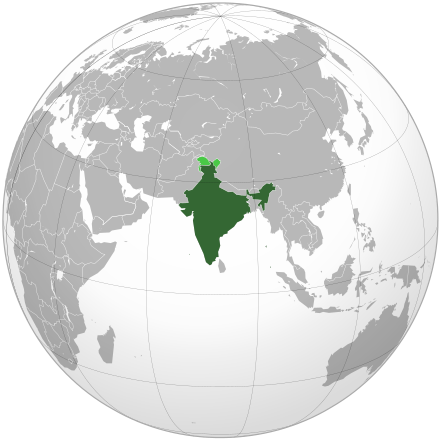
Map of India (Example, replace with local map if needed)
Second largest democracy - America.
5. Republic:
Article 54 explains about this word.
A country is called a republic if the head of state is elected by the people, directly or indirectly. There is no scope for heredity in this system.
India became a republic on January 26, 1950.
The concept of republic is borrowed from the French Constitution.
Note: The first republic country in the world - Netherlands (1795).
Another name for Netherlands - Holland.
Largest republic in the world - China.
Smallest republic in the world - Nauru.
Republic kingdoms in India during Mahajanapadas - Malla, Vajji.
Chief guest for the first Republic Day celebrations in India - Sukarno (Indonesia).
* Identify the correct statements in the following statement/statements.
- India is the largest democracy in the world.
- India has direct democracy.
- 'Recall' a direct democracy method is mentioned in the Indian Constitution.
- India has parliamentary democracy.
(Answer: 1) a, d, e (Note: There's likely a typo in the original answer options provided as 'e' is not in the list. Assuming 'd' was meant to be included.) Corrected Answer: 1) a, d
(AP SI-2018)
* Reason (A): India is a republic.
Cause (R): India has a universal adult franchise system.
Choose the correct answer:
- (A) and (R) are both true and (R) is the correct explanation for (A)
- (A) and (R) are both true but (R) is not the correct explanation for (A)
- (A) is true and (R) is false
- (A) is false and (R) is true
(Answer: 1) (A) and (R) are both true and (R) is the correct explanation for (A)) (Telangana Constables Mains – 2016)
Fundamental Rights
(FUNDAMENTAL RIGHTS)
Rights are the rules necessary for the development of individuals.
Rights come into use through laws framed and enforced by the state.
These can be seen as the power or facility available to individuals.
Without rights, individuals cannot achieve any progress.
Right is a fundamental political concept in the study of political science.
Right means an authority demanded by the people and recognized by the government.
Right can also mean having opportunity and authority.
Rights are limitations on the absolute powers of governments.
"Fundamental Rights" are the "Conscience of the Constitution" - Nehru
The main qualification to enjoy rights is to have duties - Gandhi.
"Rights are the external conditions necessary for the development of individual personality" - Ernest Barker.
"Rights are necessary for the social life of human beings. Without them, no one can normally become the best person" - H.J. Laski
Rights can be defined as the conditions that help an individual to reach their peak and achieve complete development based on their abilities and intelligence.
Fundamental Rights mean the minimum rights necessary for a human being to develop fully.
Fundamental Rights are the foundation stones for Indian democracy - Nani Palkhivala.
"Fundamental rights are granted to citizens only in democratic countries. In socialist and communist countries, the people of those countries do not have fundamental rights.
'Thomas Hobbes' is the political scientist who first proposed fundamental rights in the world.
'Fundamental Rights are like a shield of protection for the citizens of the country' - said Patanjali Sastri.
'Fundamental Rights' are like anchors that provide permanence to the Constitution - Nani Palkhivala.
'Fundamental Rights' are described as the soul and conscience of the Constitution" - Jawaharlal Nehru.
Articles 12 to 35 in Part III of the Indian Constitution explain about Fundamental Rights.
Part 3 is described as the Magna Carta of the Indian Constitution.
“Magna Carta” means “the right to question the government on an issue”
Note: Any revolutionary change in any field is called 'Magna Carta'.
Fundamental Rights were drafted influenced by the Bill of Rights in the American Constitution.
Initially, there were seven fundamental rights. But currently there are only 6 fundamental rights.
Right to Property (Article 31) was removed from the list of Fundamental Rights in 1978 by the 44th Constitutional Amendment when Morarji Desai was the Prime Minister and made a legal right.
Currently, the Right to Property is enshrined in Article 300-A in Part 12. It is being recognized as a legal right, ordinary right, civil right.
Magna Carta of 1215 AD is the inspiration for Fundamental Rights. Magna Carta, drafted in England by King John.
Magna Carta is the first document to print rights in written form in the world. ‘Magna’ means big. 'Carta' means agreement.
Note: On the occasion of the completion of 800 years since the Magna Carta Act was drafted, i.e., June 15, 2015, festivals were held in England.
Bill of Rights Act enacted in the American Constitution in 1791. There were no rights in the American Constitution in 1787. But this was added through the Bill of Rights Act in 1791.
On December 10, 1948, the General Assembly of the United Nations issued the Declaration of Human Rights.
World Human Rights Day - December 10.
* In which session of the Indian National Congress were the resolution on National Economic Program and Fundamental Rights and Duties adopted? (3) (AP Constable-2019)
- Lucknow Session, 1936
- Lahore Session, 1929
- Karachi Session, 1931
- Delhi Session, 1932
Background of Fundamental Rights:
For the first time in 1895, Lokmanya Bal Gangadhar Tilak proposed Fundamental Rights in the Swaraj Bill.
Note: 'Swaraj is my birthright' - a slogan given by freedom fighter Bal Gangadhar Tilak.
In the 1911 Calcutta session of the Indian National Congress, a resolution on rights was passed.
In 1922, Mahatma Gandhi mentioned about people's rights in the Young India magazine.
In the 1925 Commonwealth of India Bill, Annie Besant proposed that Indians should also have Fundamental Rights just like mentioned in the Irish Constitution.
In the 1927 Madras session of the Indian National Congress held under the chairmanship of M.A. Ansari, a resolution was passed that Fundamental Rights should be the basis for the future constitution.
In 1928, Motilal Nehru stated in his report that getting approval for Fundamental Rights is a necessity for citizens.
In 1931, Fundamental Rights were demanded at the Karachi session under the chairmanship of Sardar Vallabhbhai Patel. That report became the basis for including Fundamental Rights in our Constitution. Here, the National Economic Program and Fundamental Rights and Duties resolution were adopted.

Sardar Vallabhbhai Patel (Example image, replace with local if needed)
In the second Round Table Conference held in 1931, Mahatma Gandhi requested to include Fundamental Rights in the future Indian Constitution.
In 1945, the Association of Intellectuals formed under the leadership of Tej Bahadur Sapru also demanded Fundamental Rights.
Constituent Assembly - Fundamental Rights:
To incorporate rights into the constitution and give it a specific shape, the Constituent Assembly appointed an Advisory Committee of 54 members under the chairmanship of Sardar Vallabhbhai Patel on January 24, 1947.
This Advisory Committee appointed a sub-committee (sub-committee) under the chairmanship of Acharya J.B. Kripalani on February 12, 1947, to examine the Fundamental Rights.
Chairman of the Fundamental Rights Committee Sardar Vallabhbhai Patel.
Chairman of the Fundamental Rights Sub-Committee Acharya J.B. Kripalani.
B.N. Rau, advisor to the Sub-Committee, prepared a draft on rights.
In this 'draft', rights were classified as rights with legal protection and rights without legal protection.
Features of Fundamental Rights:
* In which of the articles mentioned below in the Indian Constitution, Fundamental Rights are available only to Indian citizens
(4) (AP Constable - 2019)
- 15th Article
- 16th Article
- 19th Article
- 29th Article
- 3) 19 & 29
- 1) 1, 2
- 3) 2, 3, 4
- 2) 2, 3
- 4) 1, 2, 3, 4
* Which of the following is not correct regarding Fundamental Rights.
(4) (AP Constables Mains-2016)
- Fundamental Rights are not absolute
- Some Fundamental Rights are available only to Indian citizens.
- Fundamental Rights are taken from the American Constitution
- Fundamental Rights cannot be amended
- Not Universal:
Fundamental Rights do not apply equally to all people.
All rights apply to ordinary people.
Articles 15, 16, 19, 29, 30 do not apply to foreigners.
Some rights in Article 19 do not apply to those working in the central armed forces and defense sectors.
- Not Absolute: All Fundamental Rights are not absolute. Not irrevocable.
- Having Legal Protection: Any citizen can approach the High Courts for protection and enforcement of rights.
- Primarily Negative: Fundamental Rights primarily negative: Central and state governments
- Possibility to Suspend: During a national emergency, the President can suspend the enforcement of Fundamental Rights except Articles 20 and 21.
- Traditional and Modern: Individual liberty, freedom of religion are traditional.
- Prepared on Individual Basis: These rights are mainly intended to promote individual liberty and political democracy.
- Some Fundamental Rights are intended for children, women, SC, ST, OBC minorities. Possibility of Amendment:Parliament can amend Fundamental Rights with a 2/3 majority.
Meaning, restrictions can be imposed on rights during national emergency and in extraordinary circumstances.
For the protection and enforcement of rights, the Supreme Court issues writs under Article 32 and the High Courts under Article 226.
It states what actions should not be taken by the government, which actions may violate Fundamental Rights.
Ex: Articles 14, 15, 16, 20, 21.
Those that suggest what the government should do - Articles 17, 23, 24.
Right to equality, Right against exploitation are modern.
Ex: While removing the Right to Property from the list of Fundamental Rights, Fundamental Education was included in the rights through Article 21A.
Parliament has the power to amend Fundamental Rights. – 1971, 24th Constitutional Amendment.
Types of Fundamental Rights:
Article 12 : Defines the State:
Defines the state.
It states that it is the responsibility of the state to enforce Fundamental Rights.
State means Central Government, Central Legislature, State Government, State Legislature, Local Governments, etc.
For the enforcement of Fundamental Rights, courts issue writs only to authoritative bodies.
The Supreme Court in its judgments stated that the judiciary also comes under the definition of State. It also stated that private institutions with government participation also come under the definition of State.
Article 13 : Judicial Review
Laws that were in force from before the commencement of the Indian Constitution to date / parts thereof are invalid if they are inconsistent with Fundamental Rights.
According to Article 13(1), immediately after the commencement of the Constitution, laws in force till then are invalid if they are inconsistent with Fundamental Rights, such laws are invalid.
According to Article 13(2), laws and orders that take away or limit Fundamental Rights are invalid.
Article 13(2) explains about judicial review power.
Article 13(3) defines the term law.
Judicial review power means that laws made by the Parliament, state legislatures, and GOs issued by the government are invalid if they are against the Constitution, which is called judicial review.
The term judicial review is not included in the Constitution. Instead, the definition of law (Definition of Law) is added.
Judicial review power is taken from the American Constitution.
In India, judicial review power is vested in the Supreme Court and the High Courts.
* Consider the following details related to the Indian Constitution.
- Reservation facility provided under Article 15(4) is valid over reservation facility provided under Article 371D
- The purpose of Article 12 is to have constitutional supremacy regarding Fundamental Rights
- According to Article 13(3), constitutional supremacy does not apply to non-statutory law sources
- Article 17 is implemented through the Civil Rights Protection Act 1955
Which of the following options is correct.
(4) (TSLPRBT-2018)
- 1) B & D only
- 2) A, B, & D
- 3) B, C & D only
- 4) A, D only
1. Right to Equality (Articles 14 to 18):
Article 14 states that all are equal before the law and the law shall provide equal protection to all.
"The concept of equality before law is framed in accordance with the Rule of Law in the British Constitution.
Note: The concept of Rule of Law was framed by A.V. Dicey, a constitutional expert. It is in force in England.
Equal protection by law means that equals should be treated equally in equal circumstances.
According to Article 14, although all are equal before the law, exceptions can be given in some special circumstances. Granting exemptions through reasonable, scientific classification is not against Article 14.
The principle of 'all are equal' mentioned in provision 14 does not apply to the President and Governors. Article 14 limits the scope.
- 1971, 25th Amendment
Article 14 was limited to enforce 31(C), 39(B), 39(C).
According to Article 361, the President and Governor are not answerable to any court in the performance of their official duties. No criminal cases can be filed against them. However, civil cases can be filed with two months prior notice.
According to Article 105, Article 194, members of Parliament and state legislatures are not liable to any court for the opinions expressed by them.
Similarly, foreign sovereigns, diplomats, and personnel working in the United Nations are exempted.
* Which one is not part of the Right to Equality according to the Constitution?
(4) (Telangana Constable-2019)
- Social Equality
- Abolition of Titles
- Abolition of Untouchability
- Economic Equality
Article 15 : Prohibits Discrimination
Article - 15(1): No citizen shall be discriminated against on the basis of race, religion, caste, sex, descent, region.
Article - 15(2): According to this, prohibition cannot be imposed in public utility places i.e., hotels, shops, public wells, ponds, public places.
Article - 15(3): According to this, special exemptions and facilities can be provided to women and children.
Note: In 1986, Child Labour Prohibition Act was enacted to completely eradicate child labour system in the country.
Dowry Prohibition Act was introduced in 1961 to eliminate discrimination between men and women.
Article 15(4): Special facilities and exemptions may be granted for the development of Socially and Educationally Backward Classes.
Meaning, reservations provided to SCs, STs in education and employment should not be considered as discrimination. Recognize it as protective discrimination.
Clause 15(4) was added by the 1st Constitutional Amendment in 1951.
Clause 15(4) does not include the word Backward Classes anywhere in the Constitution. Instead, what was added is “Protective Discrimination”.
Article - 15(5): Special exemptions and facilities may be granted for the development of Socially and Educationally Backward Classes (SEBC), SCs and STs in all educational institutions, private as well as government-funded.
This article was added by the 93rd Constitutional Amendment in 2005.
Article - 15(6): Implementation of 10% reservations for Economically Weaker Sections (EBCs).
Article 15(6) states that special reservations not exceeding 10% for EBCs in government educational institutions and private educational institutions should not be considered as discrimination.
Article 16 : Equal Opportunity for all citizens in government jobs
Article - 16(1): In providing government jobs, the government should not discriminate between citizens.
Article - 16(2): In government jobs, citizens should not be discriminated against on seven grounds: race, religion, caste, sex, place of birth, ancestry, and residence. (Discrimination can be shown in terms of language).
Article - 16(3): Allocating certain types of jobs to residents of certain areas should not be considered discrimination.
Through the 32nd Amendment, Article 371 (D) was specially added to Andhra Pradesh in 1973.
Article - 16(4): The State has the power to reserve certain posts for backward classes if they are not adequately represented in any government service.
Laws made by the Parliament regarding a person being a resident of that area before joining or before appointment in jobs are valid.
Ex: Residence Eligibility Act 1957.
Article - 16(4) (A): Reservation of posts or appointments for weaker sections, SC and STs who are not adequately represented in government services, is not considered as discrimination.
Social reservations exist in India. But no economic reservations.
In Balaji Raghavan V/s State of Mysore case, the Supreme Court ruled in 1963 that reservations should not exceed 50%.
In Indira Sawhney (Mandal Commission) case (1993), the Supreme Court stated that providing 27% reservation to backward classes is a valid action. However, it was stated that creamy layer should be identified among backward classes and total reservations should not exceed 50%.
However, contrary to this, the Central Government through the 76th Constitutional Amendment in 1994 provided 69% reservations in Tamil Nadu.
Through the 76th Constitutional Amendment, these reservations were included in the 9th Schedule of the Constitution in 1995.
Through the 77th Constitutional Amendment (1995), reservations were provided in promotions in jobs for SCs and STs. This amendment added clause 16(4A) to the Constitution.
Through the 85th Constitutional Amendment in 2001, it was stated in 16(4A) that reservations should be provided for SCs and STs in promotions on the basis of Consequential Seniority.
Article - 16(4)(B): There is no need to follow the 50% reservation rule in filling any backlog vacancies i.e., vacancies not filled in a year. This was added by the 81st Constitutional Amendment in 2000.
Note: In 1983, based on the recommendations of the Muralidhar Rao Committee, the Andhra Pradesh High Court quashed the provision of 42% reservation to BCs by the NT Rama Rao government in Andhra Pradesh. Because already 21% reservation was in force for SCs, STs. With the above action, it increased to 63%. The court stated that it is invalid as it exceeded 50%.
Article - 16(5): In some religious organizations, only persons belonging to that religion are allowed to fill jobs.
Article - 16(6): Implementing 10% reservations in jobs for Economically Weaker Sections (EBC).
10% Reservations for Economically Weaker Sections (EWS) from OC:
On January 7, 2019, the Union Cabinet decided to provide 10% reservations for Economically Weaker Sections in jobs in educational institutions.
This bill was passed by the Lok Sabha on January 8, 2019, Rajya Sabha on January 9, and approved by the President on January 12.
Introduced as the 124th Constitutional Amendment Bill, it became the 103rd Constitutional Amendment Act.
For this purpose, clauses 15(6), 16(6) were added to the Constitution.
15(6) - 10% in educational institutions, 16(6) - 10% reservations are being provided in jobs.
The first state to approve this law - Gujarat

Gujarat Vidhan Sabha (Example image, replace with local if needed)
When the voluntary organization Youth for Equality questioned in the Supreme Court as reservations exceeded 50% due to the implementation of 10% reservation quota, the Supreme Court refused to grant a stay on it.
Eligibility to get 10% Reservation (EWS):
- Family annual income should be less than Rs. 8 lakh.
- Family should have agricultural land less than 5 acres.
- House less than 1000 sq. ft.
- Residential space up to 100 square yards in notified municipalities, residential space of 200 square yards in non-notified municipalities (Should not have even one of the above)
Article 17 : Abolition of Untouchability / Prohibition of Untouchability
Untouchability is a social evil.
Practicing or justifying it in any form is punishable under the laws made by Parliament.
This article does not come into force on its own. Parliament must enact relevant laws for its enforcement.
'Untouchability' in common parlance is considered as untouchability.
The word 'Untouchability' has not been defined anywhere in the Constitution.
'Untouchability' was first used by H.S. Risley.
To effectively enforce provision 17, the Government of India enacted the Untouchability Offences Act in 1955.
Amending the 1955 Untouchability Offences Act, it was renamed as the Civil Rights Protection Act in 1976.
According to this Act, if the crime is proved, imprisonment up to a maximum of 2 years and the person becomes ineligible to contest elections.
Simon Commission first used the term Scheduled Castes. Gandhiji used the term Harijans.
Mysore High Court commented in 1974 that the term untouchability should not be used.
However, the Civil Rights Protection Act has failed to effectively prevent atrocities against SCs and STs.
Hence, the SC and ST Atrocities Prevention Act was enacted on September 11, 1989. This Act came into force from January 30, 1990.
Article 18 : Prohibition of Titles and Honors
18(1) Provision: No citizen shall accept titles without the permission of the government.
18(2) Provision: No titles other than educational and military titles shall be given.
18(3) Provision: Foreign citizens who have come to India for education and employment shall also not accept titles without the permission of the President.
18(4) Provision: Indian citizens who are abroad for education and employment shall also not accept titles without the permission of the President of India.
Bharat Ratna and Padma awards were introduced in 1954.
Janata government banned it from 1977 to 1980.
Later, the Congress government in Indira Gandhi's regime re-established it in 1980.
Indians must have the permission of the President to accept foreign titles.
Dr. B.R. Ambedkar commented on Article 18 as follows:
"Parliament shall formulate relevant laws and clarify the provisions of Article 18. As part of this decision, a person who violates Article 18 may even lose his Indian citizenship.”
In Balaji Raghavan Vs Union of India case (1996), the Supreme Court opined that Bharat Ratna, Padma Vibhushan, Padma Shri, etc., are not titles and should be considered as awards (honors) and there is no need to prohibit them.
However, using these 'before' or 'after' the name immediately is against Article 18.
Recently, the High Court suggested that the Padma Shri recognition of film actors Mohan Babu and Brahmanandam should be cancelled on the allegation that they used it commercially.
2. Right to Freedom and Liberty (19-22):
When the Constitution came into force, Article 19 granted 7 freedoms. Now there are 6.
* 19(1)(a) Provision: Freedom of expression, freedom to speak, and freedom of expression are granted.
* 19(1)(b) Provision: According to this article, peaceful meetings can be organized without any weapons.
However, Sikhs may be allowed to carry a small sword called Kirpan in places of worship in accordance with their religious tradition.
* 19(1)(c) : Freedom to establish organizations
Every citizen can form organizations to develop socially, economically, and politically together with other citizens.
* Through the 97th Constitutional Amendment, Cooperative Societies were also included in 19(1)(c) in 2011.
Note: Political parties in India can be formed under this article.
* 19(1)(d) : Provision allowing every citizen to move freely anywhere in the country
However, some restrictions may be imposed on the movement of citizens in view of public interest and welfare and in view of the interests of Scheduled Tribes.
Lucy D'Souza vs. Goa Government case: The court ruled that the laws framed imposing restrictions on the freedom of movement of AIDS patients are valid.
In Kaushalya vs. Uttar Pradesh Government case (1964), the court ruled that the government can impose restrictions on the freedom of movement of prostitutes.
* Ajay Kama vs. Union of India case (1988): The ruling is that the rule of compulsory wearing of helmets by two-wheeler riders does not violate their freedom of movement.
Due to Covid 19, restrictions were imposed on the movement of citizens in March 2020 during the lockdown period as per the Disaster Management Act 2005. The Epidemic Diseases Act 1897 granted this power to the state governments.
* 19(1)(e) : Provision allowing every citizen to settle permanently anywhere in the country.
Note: According to Article 370, there is no possibility of settling permanently in Jammu and Kashmir, and in agency areas as per 1/70 Act. Currently Article 370 has been repealed.
* 19(1)(f) : This states that every person may own property.
This article was removed by the 44th Constitutional Amendment.
Currently, the right to property is not a constitutional right. Only a legal right.
* Which of the following does the Indian Constitution guarantee?
(2) (TS LRBT-2018)
- a) Freedom to move freely in any part of the country
- b) Freedom to hold peaceful assemblies without weapons
- c) Freedom to acquire, possess and sell properties in any part of India
- d) Freedom to pursue any business or profession
- 1) b & d only
- 3) a, c & d only
- 2) a, b & d only
- 4) a, b & c only
* 19(1)(g) : Freedom for Indian citizens to pursue their desired profession, trade and commerce.
However, the government may impose reasonable restrictions in view of public welfare.
Ex: Some caste-based professions such as Jogini, Devadasi, prostitution have been completely banned.
* Also, to undertake some professions, certain qualifications and conditions must be complied with along with government permissions.
Ex: Medical profession, legal profession, those who sell medicines must have special qualifications as well as government permission.
Article 20 : Protection from Unfair Punishments.
* 20(1) : No person shall be punished without committing a wrong.
A person should be punished only if the act committed by him is a legal offense at the time of committing that act. And for that offense legally. Punishment should not exceed what is prescribed.
2. (Ex post Facto)
* 20(2) : No person shall be prosecuted and punished more than once for the same offense. 2. (double jeopardy)

Cartoon depicting Double Jeopardy (Example image, replace with local if needed)
In Kobad Gandhi case (2011), the Supreme Court quashed the narco analysis test as it violates this provision. Chemicals used in narco analysis - Sodium Amytal, Sodium Pentothal.
* 20(2) 2 Nemo debet bis vexari (not to be vexed twice for the same cause) (Latin) is incorporated in the Constitution based on maxim.
* 20(3) : No person shall be compelled to be a witness against himself (Self-incrimination).
* Narco analysis tests have no constitutional value.
Article 21 : Protection of Personal Liberty and Life
This freedom is paramount.
Applies not only to Indian citizens but also to foreigners.
This provision protects a person's freedom to live.
The right to life and personal liberty cannot be infringed in any way except according to the procedure established by law.
Audi Alteram Partem - No person should be punished until his submissions or statements are heard.
The concept of Procedure Established by Law is taken from the Japanese Constitution.
Law means a law enacted by the legislature in a constitutional manner. Personal liberty means that no person should be arrested or detained illegally and subjected to physical torture.
According to Article 21, suicide is also considered a crime. (IPC 309)
Provisions 20, 21 do not get revoked even when a state of emergency is imposed.
In Menaka Gandhi vs. Union of India case (1978), the Supreme Court added many aspects to the right to life - right to live with dignity, right to go abroad, right to livelihood, right to shelter, right to live in solitude, right to health etc.
The reason for the long delay in executing the death penalty for accused Ajmal Kasab in the attacks case, Nirbhaya case is to follow the due process of law prescribed in the law.
Article 21-A : Right to Education:
Right to education was added to Article 21-A through the 86th Constitutional Amendment in 2002.
It states that free and compulsory primary education should be provided to children aged 6 to 14 years.
In fact, before 2002, free and compulsory primary education was enshrined in Article 45 of the Directive Principles.
By the 86th Constitutional Amendment, it was transferred to 21-A and made a Fundamental Right.
Year of enactment of Right to Education Act 2009.
Right to Education Act came into force on April 1, 2010.
According to the Right to Education Act, schools should be within a radius of one kilometer for students studying from 1st to 5th class in their place of residence, and high school should be within 3 km radius for classes 6-8.
Private schools should allocate 25% of their total students to weaker sections.
Teacher-student ratio should be 1:30.
The expenses incurred for implementing this Act are borne by the Central and State Governments in the ratio of 65:35.
* Right to Education - Supreme Court judgments: In 1992, in Mohini Jain V/s Karnataka and Unnikrishnan V/s Andhra Pradesh cases, the court ruled that right to education is an integral part of right to life and right to get dignity, and it should be considered as a Fundamental Right.
* Article 22 : Protection from Illegal Arrests and Detentions
Article 22 explains the right of a person to be protected from illegal arrests and detentions.
This article contains the following points:
- No person should be arrested except according to law.
- The reason for arrest must be informed.
- There must be an arrest warrant for the arrest.
- The arrested person must be produced before a magistrate within 24 hours.
- After arrest, the arrested person should be given an opportunity to appoint a lawyer to argue on his behalf.
Note: There are two types of detention laws.
Preventive Detention: Taking a person into custody in advance on suspicion that he will commit a crime.
Punitive Detention: Detaining the person concerned after the crime is proved.
* The detained person must be produced before a judge within the time mentioned below
(3) (AP Constable – 2019)
- 1) 48 hours
- 3) 24 hours
- 2) 12 hours
- 4) 28 hours
Important Preventive Detention Laws:
Preventive Detention Act - enacted in 1950. However, it was repealed in 1969.
Maintenance of Internal Security Act (MISA): enacted in 1971 (Internal Security Maintenance Act). However, this Act was repealed in 1978.
National Security Act (NSA): enacted in 1980, amended in 1984.
Terrorist and Disruptive Activities Act (TADA) - 1985:
Terrorist and Disruptive Activities Prevention Act. (TADA) was repealed in 1995.
Prevention of Terrorism Act (POTA) - 2002:
This is called the Prevention of Terrorism Act. It was repealed in 2004.
Unlawful Activities Prevention Act (U.A.P.A):
Enacted in 1967. It was amended in 2012.
Conservation of Foreign Exchange and Prevention of Smuggling Activities Act - 1974:
Prevention of Illicit Traffic in Narcotic Drugs and Psychotrophic Substances Act - 1988
Essential Services Maintenance Act (ESMA) - 1988: Essential Services Maintenance Act.
Right to Information Act (RTI):
Parliament enacted the Right to Information Act in 2005.
The first country in the world to enact the Right to Information was Sweden (1776).
Right to Information Act came into force in our country on October 12, 2005.
Aruna Roy, Sandeep Pandey, Arvind Kejriwal, Loksatta Party founder Dr. Jayaprakash Narayan are the ones who fought for this right.
This Act replaced the Official Secrets Act of 1923.
3. Right against Exploitation (23-24):
Article 23: According to this, trafficking in human beings and forced labor are prohibited by this provision.
No work should be done by force against the will of individuals.
Prohibition of Bonded Labour Act (Bonded Labour Abolition Act) - 1976, Prohibition of Immoral Activities Act - 1976
In provision 23, the word 'Begar' is used. Begar means forced labor. Meaning, getting work done by people without any remuneration.
Minimum Wages Act - 1948, 1976
Equal Wages Act - 1976
According to this provision, sale of women, children, girls, promoting forced degrading work, prostitution, Devadasi/Jogini etc. are considered crimes.
Article 24 : Abolition of Child Labour
According to this, children below 14 years of age should not be employed in hazardous and other works.
Factories Act 1948.
Mines Act Year Enacted 1958.
Bidi and Cigarette Workers Act 1966.
Child Labour Prohibition Act 1986.
Supreme Court Judgments:
In M.C. Mehta Vs Tamil Nadu, 1997 case, the Supreme Court ruled that children below 14 years of age should not be employed in any kind of hazardous industry or in other works.
In Bandhua Mukti Morcha Vs Union of India, 1997 case also, the Supreme Court pronounced the same verdict and ordered to set up special rehabilitation centers for child protection and to impose a fine of Rs. 20,000 on the owner employing child laborers.
4. Right to Freedom of Religion (Articles 25 to 28):
Article 25: Every person has the right to profess, practice and propagate any religion according to the dictates of his conscience.
However, this freedom shall not harm public peace, morality, public health.
Mumbai High Court and Supreme Court have stated that preventing women from entering Shani Shingnapur temple in Ahmednagar district of Maharashtra and preventing women from entering Ayyappa Swamy temple in Sabarimala in Kerala is against Articles 14 and 25(2) of the Constitution, and women should be allowed to enter those temples without discrimination.
According to Article 25(2)(a), wearing a turban and carrying a sword is an integral part of Sikh tradition for Sikhs.
In Article 25(2)(b), the word 'Hindus' also includes Sikhs, Jains and Buddhists.
Article 26: Persons can set up and manage religious institutions without prejudice to public peace, morality, and health.
- Religious institutions, charitable institutions can be established.
- They can manage their respective institutions.
- Movable and immovable property can be acquired.
- They can manage them in accordance with the laws in force.
Ayodhya Verdict:
The Supreme Court delivered its final verdict on November 9, 2019, on the Ramjanmabhoomi-Babri Masjid land ownership dispute in Ayodhya.
The 2.77 acres of disputed land belongs to Hindus, it said.
Ordered to allot 5 acres of alternative land in Ayodhya itself for the construction of a mosque.
Those who gave the Ayodhya verdict:
A five-judge bench headed by Chief Justice of India Ranjan Gogoi delivered the verdict in the disputed Ayodhya case today. The bench included Supreme Court Chief Justice Ranjan Gogoi, Justice Ashok Bhushan, Justice SA Bobde, Justice DY Chandrachud, Justice S Abdul Nazeer.
Article 27: No taxes shall be levied for the propagation or maintenance of any particular religion.
This provision only prohibits levying of taxes.
However, the government may collect fees from the people for providing special services on religious basis.
Article 28: Religious instruction shall not be imparted in government educational institutions and educational institutions receiving aid from the government.
5. Cultural and Educational Rights (Articles 29 to 30):
Article 29: Protection regarding Minority Interests.
29(1): Every citizen has the right to preserve his script and culture.
29(2): No citizen shall be denied admission to educational institutions on grounds of race, religion, caste, language.
Article 30: According to this provision, minority groups can establish and manage special institutions.
Minority groups (minorities) are not defined in the Constitution. But legally minorities are of two types -
- Religious Minorities
- Linguistic Minorities
The country as a whole is taken as a unit to identify religious minorities, while the state is taken as a unit to identify linguistic minorities.
All religions other than Hindus are minorities. Linguistic minorities vary from state to state.
Minorities can establish educational institutions. In the management of them i.e., admissions, recruitment, etc., the government should not interfere, the Supreme Court ruled in the All Saints V/s Andhra Pradesh Government (1980) and St. Xavier's College V/s Gujarat Government (1974) cases.
Right to Property Article 31 Removed.
31 (A): Laws enacted by governments in the name of land reforms, should not be challenged in any court on the ground that they are violating rights.
31 (B): Schedule 9 was added under this article.
While implementing the items in Schedule 9, it should not be challenged in any court that they are violating rights.
Note: Articles 31(A) and 31(B) were added to the Constitution through the First Constitutional Amendment, 1951.
31 (C): Article 31(C): Article 14 should be limited to enforce Articles 39(b), 39(c) of Directive Principles in Part 4. Laws enacted by governments taking inspiration from provisions should not be challenged in any court that they are violating rights.
Article 31(C) was added to the Constitution through the 25th Constitutional Amendment in 1971.
These provisions were framed to limit the Right to Property in Fundamental Rights.
Note: Right to Property (Article 31) was removed from the list of Fundamental Rights through the 44th Constitutional Amendment of 1978 and made a legal right in provision 300(A) of Part 12.
* Currently, in which article and part of the Indian Constitution is the Right to Property enshrined
(1) (APSI-2018)
- 1) 300A, PART - XII
- 2) 200A, PART - XII
- 3) 300 A, PART - XVIII
- 4) 200A, PART - XVIII
* Writ issued to release a person who is illegally detained
(1) (AP Constables-2018)
- 1) Habeas Corpus
- 2) Mandamus
- 3) Quo Warranto
- 4) Certiorari
6. Right to Constitutional Remedies - Article 32:
Those who described this right as the soul and heart of the Indian Constitution are Dr. B.R. Ambedkar
If Fundamental Rights are violated, one can go to court through the Right to Constitutional Remedies.
The Constitution has entrusted the responsibility of protecting Fundamental Rights to the Supreme Court and the High Courts.
If Fundamental Rights are violated, the Supreme Court issues writs under Article 32.
Similarly, the High Court issues writs under Article 226.
Writs:
Writ means order or command.

Gavel and Indian Flag (Example image, replace with local if needed)
Courts have adopted the system of issuing writs from the British Constitution.
The Supreme Court is called the protector of Fundamental Rights.
'Writ' is a 'Latin' word.
Writs are of 5 types - they are -
1. Habeas Corpus:
This is the oldest writ.

Habeas Corpus Act 1679 Title Page (Example image, replace with local if needed)
Habeas means 'Have', Corpus means 'Body'.
Meaning comes.
This writ is issued when personal freedoms are violated.
Writ stating that the arrested person should be produced in the nearest court within 24 hours.
It is described as a liberal writ and is described as a tool to protect personal freedoms.
This writ can be issued against government agencies and private individuals.
This writ cannot be issued against the President, Governor, foreign ambassadors.
2. Mandamus:
In terms of language, Mandamus means order.
We command means “We command you”.
This writ can be called the 'highest command' issued by the Supreme Court (or) High Court.
Order issued by courts to a government official to perform his duty properly.
This writ is issued only against government employees and institutions.
This writ cannot be issued against the President, Governor, foreign ambassadors, private individuals.
3. Prohibition:
In terms of language, Prohibition means prohibition.
If any lower court or tribunal is hearing cases beyond its jurisdiction, the court orders to stop the hearing until further orders.
The main purpose of this writ is to prevent lower courts from exceeding their jurisdiction.
Prohibition applies only to judicial bodies.
Does not apply to administrative bodies and statutory bodies.
4. Quo Warranto:
In terms of language, it is called 'By What Warrant'.
Meaning “By what authority” to question.
If someone has illegally entered public office or misused public office, the courts question the authority of the person in office to continue in that position.
If legitimacy is lacking, they order to vacate the post immediately.
The main purpose of this writ is to prevent misuse of public office.
5. Certiorari (Certiorari)
(Higher Court Review Power):
Certiorari means 'To be certified'.
When a lower court hears a case beyond its jurisdiction and gives a verdict, the order is to quash the verdict and transfer the case to a higher court.
The purpose of this writ is also to prevent lower courts from exceeding their jurisdiction.
Injunction: Injunction is a court order to do a work or not to do a work. It is issued in civil disputes to maintain status quo. There is no mention of it in the Constitution.
* Who has the power to impose restrictions on Fundamental Rights?
(2) (AP Constable Prelims-2016)
- 1) Supreme Court
- 2) Parliament
- 3) President
- 4) No permission to impose restrictions
Article 33 :
Parliament has the right to deny Fundamental Rights to the armed forces.
Parliament has the right to deny Fundamental Rights to those working in central forces, forces using for maintenance of law and order, those working in intelligence agencies, those working in communication sector related to defense.
Article 34 : Restrictions on Fundamental Rights when Martial Law is in force
Indian Parliament decides to what extent Fundamental Rights apply in areas where Martial Law is in force.
The concept of Martial Law in India is taken from English Common Law.
Note: There is no definition of “Martial Law” anywhere in the Constitution.
Generally, it is called 'Military Rule'.
Article 35 :
Parliament has the power to legislate regarding Fundamental Rights.
Important Cases related to Fundamental Rights - Supreme Court Judgments
- A.K. Gopalan Vs State of Madras - 1950:
- Shankari Prasad Vs Union of India - 1951:
- Bela Banerjee Vs West Bengal Government - 1954:
- Sajjan Singh Vs State of Rajasthan - 1964:
- Golak Nath Vs State of Punjab - 1967:
In 1950, the Supreme Court ruled that Section 4 of the Preventive Detention Act made in 1950 was invalid as it was against judicial review power.
The Supreme Court examined the issue related to the First Constitutional Amendment in this dispute.
The court ruled that this amendment is constitutional.
In this case, the Supreme Court used the power of judicial review for the first time.
This dispute is related to Right to Property.
The government should pay market value compensation when the government acquires people's property', the court ruled.
This case is related to the constitutional amendment power.
The 17th Constitutional Amendment made regarding Right to Property was declared constitutional.
In this case, the Supreme Court questioned the Land Reforms Act enacted by the Punjab government.
The Supreme Court ruled that Parliament does not have the power to amend Fundamental Rights.
In this case, the Supreme Court declared that a 'Special Constituent Assembly' should be constituted to amend Fundamental Rights.
- Kesavananda Bharati Vs Kerala Government - 1973:
- Minerva Mills Vs Union of India – 1980:
- Indira Sawhney Vs Union of India - 1992:
- Unnikrishnan Vs Andhra Pradesh Case - 1992 and Mohini Jain Vs Karnataka Case - 1992:
- Menaka Gandhi Vs Union of India (1978) In this case, the Supreme Court explained Due Process of Law (related to freedom).
- St. Stephen's College Vs University of Delhi The Supreme Court ruled in 1991 that minority institutions can admit students who have scored less than standard marks.
- National Legal Services Authority Vs Central Government (2014) In the case between, the Supreme Court ruled that not being able to express their gender and not recognizing their rights means denying their equality to transgenders.
The 24th and 25th Constitutional Amendments intended to amend Fundamental Rights were questioned in the Supreme Court.
Contrary to the verdict given in the Golaknath case, the Supreme Court ruled that Parliament has the power to amend Fundamental Rights, but should not change the basic structure.
The term Basic structure was used by the Supreme Court for the first time in this case.
42nd Constitutional Amendment was questioned in the Supreme Court in this case.
"Fundamental Rights are part of the constitutional structure and it is against the Constitution to reduce or abolish them," the Supreme Court declared.
The Supreme Court upheld the issue of providing 27% reservation to backward classes.
In these two cases, the Supreme Court ruled that if the Right to Education is not there in Fundamental Rights, there is no meaning to Right to Life and Right to Dignity, and Primary Education should be recognized as a Fundamental Right.
No comments:
Post a Comment